Medicare enrollment isn't always about turning 65. A change in your circumstances may open another path to Medicare.

Certain life events and changes in health coverage can create a Special Enrollment Period or another qualifying opportunity to enroll in Medicare.

If you believe you have a qualifying enrollment opportunity—or you’ve been referred to Zinn for new-Medicare support—your first step is to tell us about your situation.

We'll Start by Understanding Your Situation

Tell Us What Changed

We’ll gather information about your current coverage, recent life event, and Medicare enrollment circumstances.

Review Your Eligibility

We’ll evaluate whether your situation appears to qualify for an applicable Medicare enrollment opportunity.

Complete Your Intake

If your situation is appropriate for Zinn’s Medicare support, we’ll collect the information needed to move forward.

Schedule Your Next Step

Once your eligibility and circumstances have been reviewed, we’ll determine the appropriate next step and schedule service when applicable.

Examples of Medicare SEPs / Qualifying Events

Medicare enrollment opportunities aren’t limited to turning 65. Certain changes in your coverage, living situation, or eligibility may create a Special Enrollment Period (SEP).

Some examples include:

Your Medicare plan is changing
If your Medicare Advantage or prescription drug plan is no longer available in your area, leaves the Medicare program, or has certain changes to its Medicare contract, you may have additional enrollment options.

You’ve moved
Moving to a new location can affect your Medicare Advantage or prescription drug plan options—particularly if your new address is outside your plan’s service area. Certain moves, including returning to the U.S. after living abroad, may also create an enrollment opportunity.

You’ve lost other health coverage
Losing employer or union group health coverage may give you an opportunity to enroll in Medicare or make changes to your Medicare coverage. This can include situations involving retirement, leaving a job, or losing COBRA coverage.

Your Medicaid or Extra Help status has changed
Gaining or losing Medicaid eligibility—or becoming newly eligible for Extra Help with Medicare prescription drug costs—can affect your Medicare enrollment options.

You’ve moved into or out of a care facility
Moving into, living in, or moving out of certain institutions, such as a skilled nursing facility, rehabilitation facility, or long-term care hospital, may provide additional opportunities to change your Medicare coverage.

You continued employer coverage after turning 65
If you delayed Medicare Part B because you had health coverage through active employment, you may have a Special Enrollment Period when that employment or coverage ends. The rules depend on the type of employer coverage and your circumstances.

Not Sure If You Qualify? That's Okay.

You don’t need to know the Medicare rules or determine your own eligibility before reaching out. That’s what the initial review is for.

Eligibility for a Special Enrollment Period or other Medicare enrollment opportunity is determined according to applicable Medicare rules. Initial review does not guarantee eligibility or enrollment.

How does Medicare work?

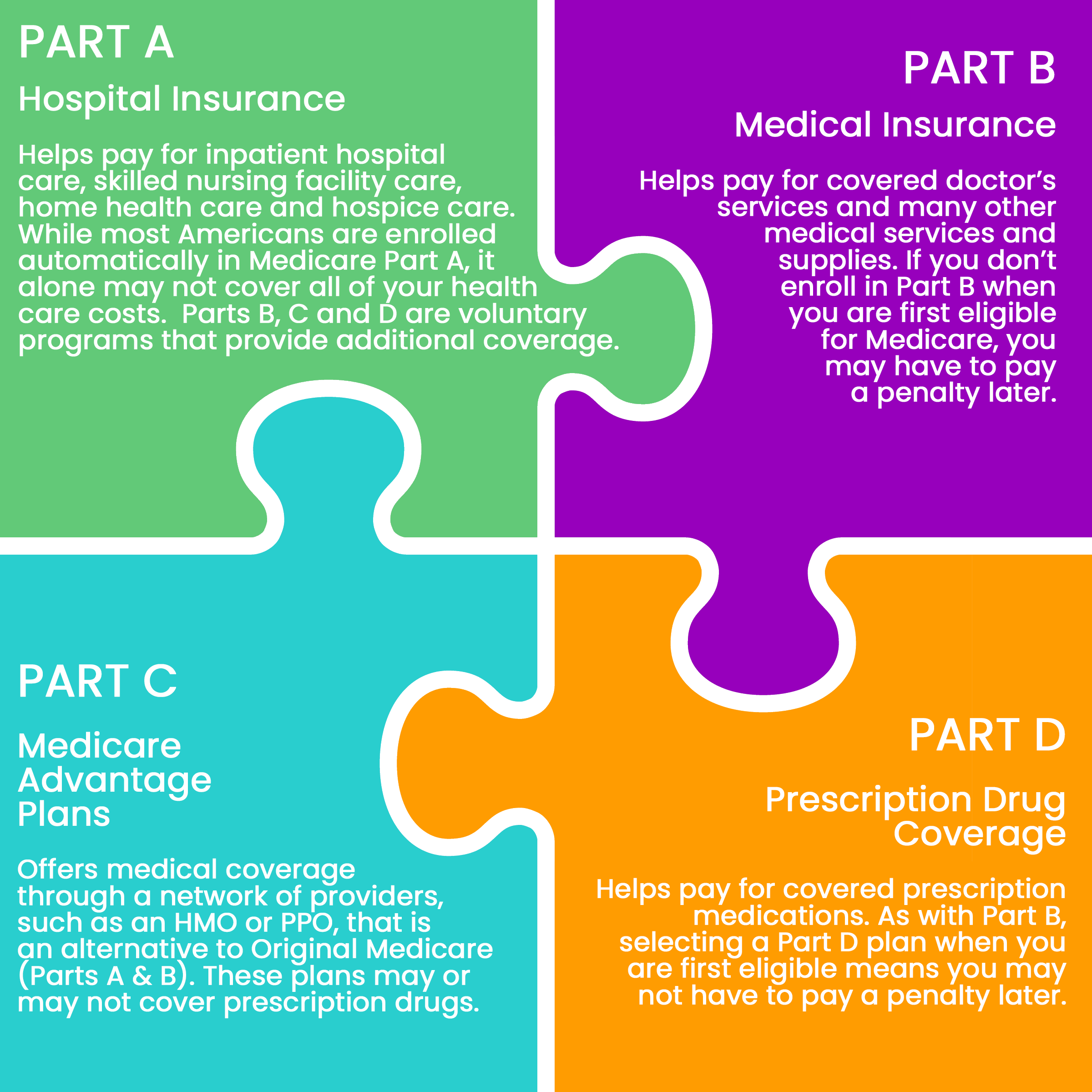
Medicare is the nation’s largest health insurance program, covering health care services such as hospital stays, skilled nursing and physician services for millions of Americans. There are four parts to Medicare, each providing different types of health care services.

Understanding Your Medicare Choices

You can choose from two paths to reach the Medicare coverage you need. Here’s how:

How Medicare Drug Plans (Part D) Work in 2027

Medicare Part D helps cover the cost of prescription drugs and is available to anyone with Medicare Part A and/or Part B. You get Part D by enrolling in a standalone drug plan or a Medicare Advantage plan (Part C) that includes drug coverage.

$700

You pay 100% of drug costs until you meet your plan’s deductible (up to $700 in 2027). Some plans have a $0 deductible for certain drug tiers.

$2400

You pay up to 25% of coinsurance for medication covered in your plan’s formulary or list of covers medications. Your maximum out-of-pocket cost will be $2400.

$0

Once you have incurred the maximum out-of-pocket cost of $2400, your coverage does not end. All medications covered on the formulary from this point forward will be covered at 100%.

Restart

No matter what, everything resets on January 1, and you return to the deductible stage at the beginning of the next year.

How Medicare Drug Plans (Part D) Work in 2027

Medicare Part D helps cover the cost of prescription drugs and is available to anyone with Medicare Part A and/or Part B. You get Part D by enrolling in a standalone drug plan or a Medicare Advantage plan (Part C) that includes drug coverage.

$700

You pay 100% of drug costs until you meet your plan’s deductible (up to $700 in 2027). Some plans have a $0 deductible for certain drug tiers.

$2400

You pay up to 25% of coinsurance for medication covered in your plan’s formulary or list of covers medications. Your maximum out-of-pocket cost will be $2400.

$0

Once you have incurred the maximum out-of-pocket cost of $2000, your coverage does not end. All medications covered on the formulary from this point forward will be covered at 100%.

Restart

5 Tips for Reducing Your Pharmacy Spend

Find A Pharmacy

Review your plan’s Rx Network & pay attention to the preferred, standard, & specialty pharmacy

Stay In Network

Your medical carrier partners with select pharmacies to lower the cost of medications. If you go out-of-network, you will pay higher costs!

Stay In Network

When you receive a prescription from your doctor, you can ask for a lower-cost option such as a generic equivalent. Mail order is also a great option for maintenance.

COPAY CARDS & PHARMACY ASSISTANCE PROGRAMS

Copay cards/assistance may be available through the RX manufacturer.

Medicare GLP-1 Bridge Program

The Medicare GLP-1 Bridge is a short-term demonstration program starting July 1, 2026, offering eligible Medicare Part D beneficiaries’ access to certain GLP-1 weight-loss medications for a flat $50 monthly copay.

Covered Medications

The program covers three GLP-1 drugs specifically for weight reduction and maintenance:

Wegovy® (injection and tablet formulations)

Zepbound® (KwikPen formulation only; single-dose pens and vials are excluded)

Foundayo® (all tablet formulations)

Medicare
GLP-1
Bridge
Program

The Medicare GLP-1 Bridge is a short-term demonstration program starting July 1, 2026, offering eligible Medicare Part D beneficiaries’ access to certain GLP-1 weight-loss medications for a flat $50 monthly copay.

Covered Medications

The program covers three GLP-1 drugs specifically for weight reduction and maintenance:

Wegovy® (injection and tablet formulations)

Zepbound® (KwikPen formulation only; single-dose pens and vials are excluded)

Foundayo® (all tablet formulations)

Additional Coverage Options for Seniors 65+

Protect your smile and eyesight with affordable ancillary plans.
Protect your loved ones with coverage designed for peace of mind.
Ensure coverage for funeral costs, medical bills, and other end-of-life expenses.
Travel with confidence! Medical coverage, evacuation, trip interruption & more.
Call Now Button